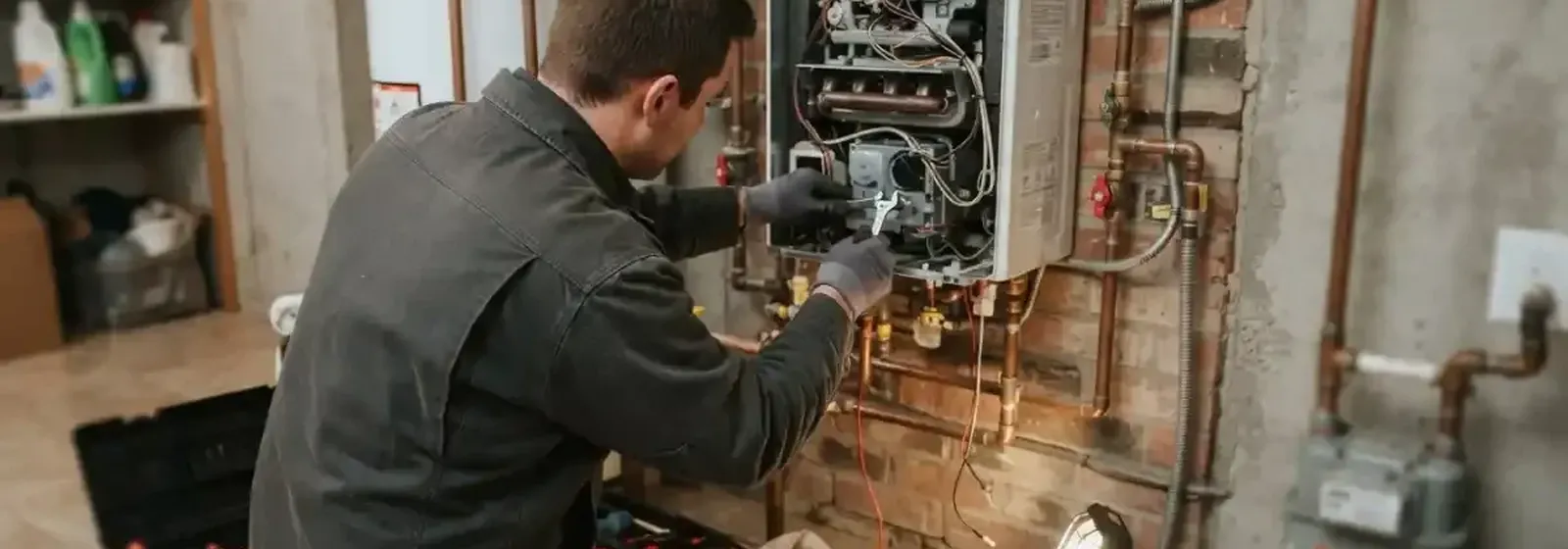
Gas smell or no heat: what to do first
If you smell gas near the boiler, do not touch switches, do not use a phone inside and do not try to relight anything. Go outside, then call 911 or your gas utility (for PECO customers, 1-800-841-4141), as the Pennsylvania Public Utility Commission advises. We work on the boiler only after the utility has cleared the house.
If there is no gas odor and no carbon monoxide alarm, the situation is urgent but manageable. Check the thermostat, confirm the boiler switch is on and note the pressure gauge reading and any error light. Those details help the dispatcher decide what to bring.
Before we arrive: keep the house safe in a heat outage
A few steps keep pipes from freezing and the house livable while you wait.
Check the basics
Confirm the thermostat is set to heat and the batteries are fresh, the boiler switch and breaker are on, and the fuel supply is open.
Protect the pipes
Open cabinet doors on exterior walls, let a faucet drip on the coldest wall and keep interior doors open so warmer air moves around.
Use safe supplemental heat
Use electric space heaters plugged directly into a wall outlet, away from curtains. Never run a grill, oven or generator indoors, because of the carbon monoxide risk.
Note the symptoms
Write down the pressure reading, any noises, leaks and which rooms are cold. Photos of the gauge and any error code speed up the visit.
Why boilers fail in a Pennsylvania cold snap
A boiler runs hardest when the weather is worst. The longest run times and coldest return water stress circulator pumps, zone valves and the burner, and a part that was marginal in October gives out in January.
Census heating data for 2020 to 2024 shows roughly 1,700 occupied Horsham homes heated with fuel oil, alongside about 4,000 on utility gas. Some of those homes use a boiler and others a furnace, and the Census does not say which. These figures are estimates with margins of error, so we ask what you have rather than assume.
No heat at all
Causes include a tripped switch, a thermostat or power fault, a failed circulator, a lockout on the burner or an empty fuel supply.
Radiators or baseboard cold in some rooms
Trapped air, a stuck zone valve or a closed or clogged section commonly cause part-house heat loss.
Banging, knocking or gurgling
Air in the system, low water or flow problems show up as noise. A loud bang from the boiler itself is worth shutting down.
Water on the floor
Leaks come from valves, pump flanges, the relief valve or a failing boiler section. We find the source before we recommend repair.
Pressure too high or too low
A failing expansion tank or a slow leak shifts system pressure and can open the relief valve.
Boiler keeps shutting off
Short cycling can come from an oversized setting, dirty sensors, a poor vent or a failing limit control.
Boiler down and the house getting cold?
Give the dispatcher the boiler type, the fuel and what the gauge reads. We book same-day service when available, day or night. Call (215) 714-6692.
Hydronic, baseboard and radiator systems: what we repair
A hydronic system heats water in the boiler and pumps it through pipes to baseboard fin tubes or cast iron radiators, then returns it to be heated again. The loops are closed, so air, pressure and flow are the three things to get right.
We repair circulator pumps, zone valves, expansion tanks, air vents and bleeders, pressure relief and fill valves, and the piping around them. We also trace leaks in supply and return lines using the same methods as our leak detection service. Boilers with a separate indirect water heater tank are tested on both sides.
Bleeding air and balancing zones
Air trapped at the top of a radiator or a baseboard run blocks hot water from reaching it. Bleeding the air lets the line fill, and a cold radiator often warms up in minutes. If you bleed it yourself, have a rag and a pan ready, and stop when water, not air, comes out.
If one zone stays cold after bleeding, the problem is probably a zone valve, a thermostat or the circulator. We test each, since replacing the wrong part wastes time and money. Do not keep adding water at the fill valve without finding why pressure dropped, because that points to a leak.
| What you notice | Likely cause | Our first check |
|---|---|---|
| Whole house cold, boiler silent | Power, thermostat, burner lockout or fuel | Switch, breaker, thermostat call, reset and fuel |
| One zone cold | Zone valve, thermostat or trapped air | Zone valve motor and bleeders |
| Pressure drifting down | Slow leak or failing fill valve | Visual leak check and gauge test |
| Relief valve dripping | High pressure, bad expansion tank or valve | System pressure and tank charge |
| Rumbling or kettle noise | Scale or sludge in boiler | Flow, temperature rise and water condition |
Boiler leaks and water damage
A boiler leak is easy to underestimate because the water often runs along pipes and drains away before you see it. Rust stains on the floor, a crusty buildup on a valve or a gauge that creeps down are all signs of a slow leak.
For an active leak, shut the water feed to the boiler and, if it is safe, turn off its power. If a heating pipe has frozen and split, our burst pipe repair team can handle the pipe while we address the boiler. We do not weld or reseal a cracked boiler section, because that needs replacement of the unit.
- 1
Safety check
We confirm there is no gas odor or carbon monoxide, and check the vent, relief valve and discharge line.
- 2
Diagnose the failure
We test power, controls, circulators and valves, then check pressure, temperature and flow around the loop.
- 3
Quote the repair or the alternative
You hear the price for the repair, and for replacement if the boiler is beyond sensible repair, before work begins.
- 4
Repair, purge and test
We replace the failed part, purge air, restore pressure and run the system until every zone heats.
What affects the price of boiler repair
Boiler repair prices vary because systems and failures differ so much.
The failed component
An air vent or a thermostat is small. A circulator, a zone valve manifold or a boiler control is more.
System type and age
Older cast iron radiator systems and newer condensing boilers need different parts and testing.
Access to the piping
Boilers in tight utility rooms and lines behind finished walls add labor.
Leak extent
A leaking valve is a small job. A buried or in-wall leak takes detection and opening up.
After-hours timing
A night or weekend call can carry a different call-out charge than a weekday visit, and we state it before you commit.
If a repair approaches the cost of a new boiler, we say so. Want your real number? Call (215) 714-6692.
Late-night and weekend heat failures
Heat failures cluster on the coldest nights, and our dispatch line is staffed for exactly that. We book the earliest same-day or next-morning appointment available, and we tell you what to do about frozen-pipe risk while you wait.
We serve Horsham and nearby boroughs and townships, including Ambler and Hatboro.
What we do not do
We do not relight a boiler that has locked out for a safety reason without finding out why. We do not bypass a limit control or a relief valve. For fault inside an oil burner's combustion setup, we tell you plainly if it needs an oil heating specialist, and we keep working on the plumbing side of the system.
What to tell the dispatcher
- The fuel (gas, oil or electric) and boiler type (hot water, steam, radiators or baseboard)
- Pressure gauge reading and any error light or code
- Any water on the floor or noises from the boiler
- Any gas odor or CO alarm (if yes, call 911 first)
- Which rooms or zones are cold
Questions about boiler repair in Horsham
Yes. Our dispatch line answers 24/7, and we book the earliest same-day or next-morning appointment available. While you wait, protect the pipes, use safe heat and leave the house if you smell gas.
Leave the building immediately, avoid switches and phones inside and call 911 and your gas utility from outside. Do not return until they say it is safe.
Trapped air is the usual cause. Bleeding the radiator valve releases it. If it keeps coming back, there may be a leak, a failing air vent or a circulation problem.
A slow leak, a faulty fill valve or a failing expansion tank are the common causes. Adding water repeatedly masks the cause, so we find the leak first.
We work on hydronic hot water systems, baseboard and radiators. Steam is a different system, so tell us which you have when you call and we say plainly whether we can take the job or a specialist should.
Shut off the water supply to that section, open a faucet and do not use an open flame to thaw it. Call us and we deal with the heat and the pipe together.
A part failure on a boiler in good shape is usually a repair. A cracked section, repeated failures or a leak inside the unit often means replacement, and we give you both prices. A boiler replacement is heating work, and the Township permit page requires a permit for it, so ask Code Enforcement at (215) 643-3131 who files it.
We handle the plumbing and hydronic side, such as pumps, valves, leaks and expansion tanks. Faults inside the oil burner itself, such as the nozzle, burner controls or fuel tank, go to an oil heating specialist, and we tell you so on the first visit.
Sources we checked
Local facts on this page come from these public pages. Plumbing work in Pennsylvania falls under the Uniform Construction Code, which adopts the International Plumbing Code (IPC) provisions, so ask Horsham Code Enforcement which edition applies before a permit is pulled. Rules and phone numbers change, so confirm with the office before you act.