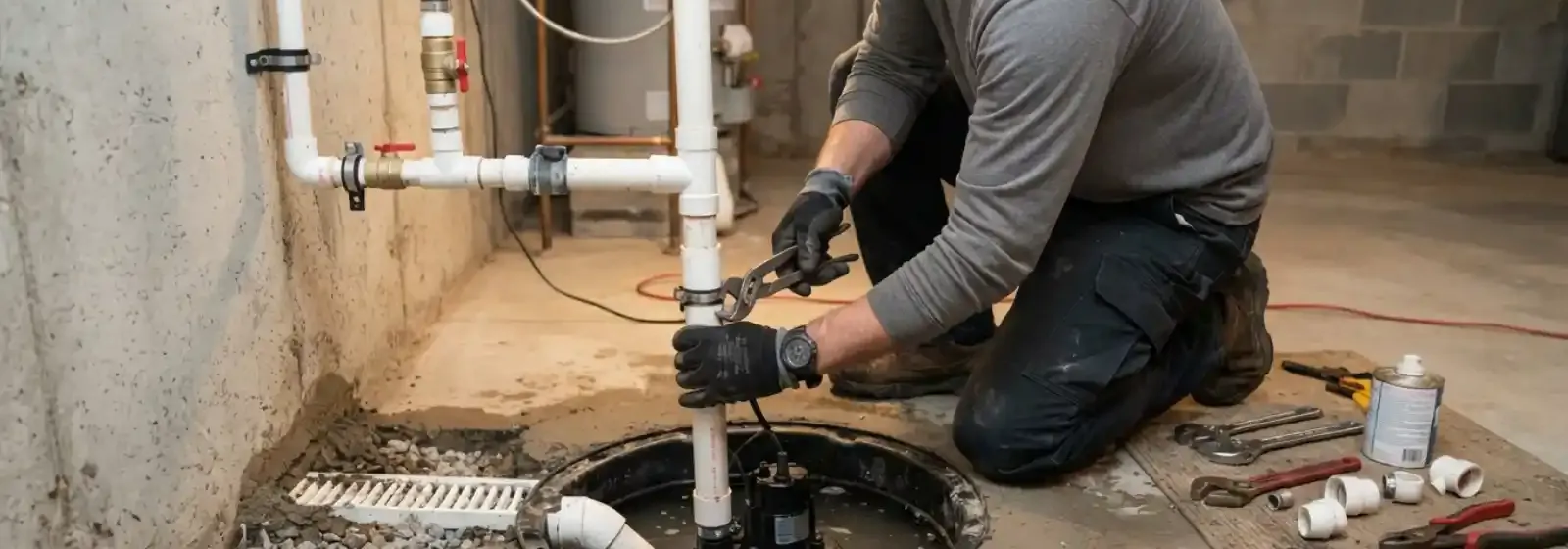
Start with where the water will go
The discharge route is the part most homeowners skip, and it is the part that causes neighbor disputes and winter icing. The pipe should carry water well away from the foundation, so it does not simply return to the pit. It should also slope away from walkways, because the township requires written permission before sump water goes onto a neighbor's property.
Sump water belongs in a storm drain, a dry well, or a lawn outlet on your own lot. Horsham Water & Sewer Authority does not accept it in the sanitary sewer, so the pipe goes outside. That keeps the authority's plant from taking on rain water and keeps you clear of a rule violation.
Choosing a pump type
Submersible pump
Sits in the pit, runs quiet, and handles most homes. It sits in water, so quality seals matter.
Pedestal pump
The motor sits above the pit on a column. It is easier to service but louder, and it needs a narrow pit.
Battery backup pump
A second pump on a separate battery runs when power fails, which is when storms hit hardest.
Water-powered backup
Uses municipal water pressure to run a backup and needs no battery, but it consumes water while running. Ask whether your water supply allows it.
Many homeowners pair a primary submersible pump with a battery backup. Horsepower is typically around one third for a standard house, with larger units for high water tables. Match the pump to the volume of water your basement actually sees, not to a catalog headline.
How the installation is done
- 1
Pick the pit location
The low corner of the basement, or where water appears first, is usually the best spot. If drain tile exists, the plumber taps it into the pit.
- 2
Cut the slab and dig the pit
A saw cuts the concrete, the pit is dug, and a liner (often around 18 inches wide) is set with gravel at the base. Dust control and a clear path are needed.
- 3
Set the pump, check valve, and discharge pipe
The pump sits on a firm base, and a check valve on the discharge line stops water from running back into the pit. The pipe runs through the rim joist to the outside.
- 4
Seal the lid and wire it
A sealed lid reduces moisture and odors, and the pump plugs into a dedicated outlet, ideally on a ground fault protected circuit.
- 5
Test
The plumber fills the pit with water to start the float, then watches the pump run and shut off cleanly.
Test it yourself every few months
Pour a bucket of water into the pit and watch the float rise, the pump start, and the water drain. If the pump hums but does not run, or it cycles every few seconds, call before the next storm.
Sump pumps often fail at the moment of heaviest use because the float was stuck or the check valve clogged. A short test costs nothing.
Sump pump struggling this season?
Call (215) 714-6692 for a pit and pump check. We can also look at basement waterproofing if water keeps coming through a wall.
What affects the price of a sump pump installation
The pump is usually the smaller line item. These five factors shift the quote most.
New pit versus replacing a pump
Replacing a pump in an existing pit is a short job. A new pit means cutting concrete, excavating, and hauling the spoil away.
Discharge distance and route
A short run through the rim joist is simple. A long run, a buried line, or a pop-up emitter in the yard adds material and labor.
Backup system
A battery or water-powered backup adds hardware and wiring. It is the item most worth keeping when a quote is trimmed.
Electrical access
The pump needs a nearby outlet. Adding a dedicated circuit is a separate trade and a separate cost.
Drain tile connection
If the house has perimeter drain tile, connecting it correctly to the pit is part of the job, and finding it can take time.
Water tables, soil, and rain history differ across the Horsham area, so no two basements are priced alike. Want your real number? Call (215) 714-6692.
Radon and the sump pit
Cutting the basement slab is a good moment to check for radon. If you plan to finish the space, test first and share the result with your installer.
A sealed pit lid keeps humid air and odors in the pit, and it keeps small items from falling in. Seal it with the cable and pipe grommets snug, and keep the lid removable because the pump will need service someday.
Winter, ice, and the outside end of the pipe
In a Pennsylvania January, an outdoor discharge can freeze and send water back to the pit. Pipe that slopes continuously away from the house drains itself after each cycle, which prevents most ice plugs. Some installs add a pop-up emitter or a second outlet so water has an escape if the first one freezes.
Keep the outlet clear of leaves and snow, and look at it after a freeze. A pump that runs but moves no water is often fighting a blocked pipe, which the motor cannot clear and which shortens its life.
For repairs on an existing pump, our sump pump installation and repair page lists the common failure points. We also visit homes near Warrington and Ambler, and the wet-basement questions are the same: where does the water enter and where can it leave.
Horsham's sewer rule, neighbor rule and Ida lesson
The authority's Rules and Regulations (revised 2/9/26) bar sump, storm, ground and roof water from the sanitary sewer, and the authority tells homeowners to drain sump pumps onto their own property. The township adds that sump water may not be sent onto a neighbor without written permission. So plan the outlet on your own lot, sloped away, and never tie it into a floor drain or sewer cleanout.
On September 1, 2021, the remnants of Ida brought what the National Weather Service called catastrophic flash flooding, with roads flooded at Pennypack Creek crossings near Willow Grove. Horsham drains to the Neshaminy, Wissahickon and Pennypack watersheds, so heavy storms can load the ground from several directions. Storms also cut power, which is why a battery backup earns its cost. The authority adds that basic homeowner policies often exclude sump and sewer backup, so ask your agent.
A pit cut through the slab is also the moment to check radon. DEP reports that about 40 percent of tested Pennsylvania homes exceed the 4 pCi/L guideline, and test kits are sold at hardware stores. Test before you finish the space.
Questions and answers
It depends on whether you need a new pit, how long the discharge run is, and whether you add a backup. We give a clear price before work starts after seeing the basement. Call (215) 714-6692 to describe it.
No. Horsham Water & Sewer Authority's rules ban sump, storm, ground and roof water from the sanitary sewer, and it says sump pumps should drain onto your own property. Your outlet also cannot send water onto a neighbor without their written permission, so the plumber plans the run on your lot.
If your basement floods during storms, yes, because storms often take the power out. A backup pump on its own battery covers that gap.
Many last roughly 7 to 10 years, with heavy use shortening that. Testing the float and replacing the check valve extend the life.
A high water table, a stuck float, or a failed check valve can all cause it. If it cycles every few seconds, call for a check.
Testing is the only way to know. About 40 percent of tested Pennsylvania homes exceed the 4 pCi/L guideline, so test before finishing the basement and share the result with whoever works on the slab.
Sources we checked
Local facts on this page come from these public pages. Plumbing work in Pennsylvania falls under the Uniform Construction Code, which adopts the International Plumbing Code (IPC) provisions, so ask Horsham Code Enforcement which edition applies before a permit is pulled. Rules and phone numbers change, so confirm with the office before you act.
- horshamwater-sewer.com/sites/default/files/2026-02/horsham-water-se... Authority rules
- horshamwater-sewer.com/did-you-know Authority page
- horsham.org/10737/Permits Township page
- weather.gov/phi/eventreview20210901 State agency
- files.dep.state.pa.us/water/Wastewater%20Management/eDMRPortalFile... State agency
- pa.gov/agencies/dep/programs-and-services/radiation... State agency
- horshamwater-sewer.com/sewer-backups Authority page