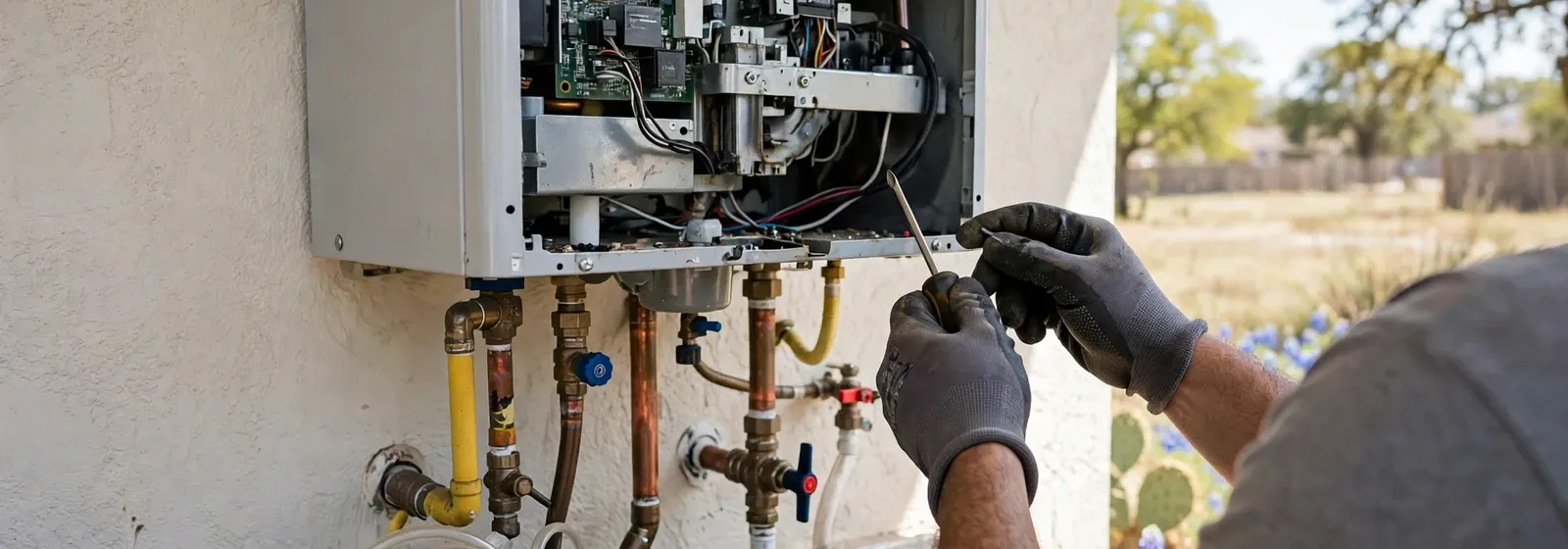
How a tankless heater works and what it needs
When you open a hot tap, a flow sensor detects water moving and the unit lights a gas burner or energizes electric elements. The water passes through a heat exchanger and leaves at the set temperature. No flow, no heating.
That design makes demands on the house. A gas model draws far more gas at once than a tank burner, so it often needs a larger line, and a power-vented exhaust path. An electric model can need a very large circuit, which some older panels cannot supply.
Gas or electric tankless: which fits your house
| Question | Gas tankless | Electric tankless |
|---|---|---|
| Output at a high flow | Higher, handles several fixtures better | Limited by available amperage |
| What the house needs | Gas supply sized for the burner, sealed vent | Large dedicated circuit and panel space |
| Venting | Required, usually through a wall or roof | None |
| Typical use | Whole house | Point of use or smaller homes |
| Biggest installation hurdle | Gas line size and vent route | Panel and wire capacity |
Census estimates for 2020 to 2024 show about 4,000 occupied Horsham homes heated with utility gas and about 3,700 with electricity. Both fuels are common, so which tankless model suits you depends on your meter, your panel and your vent options, not on a local rule.
Descaling and flushing: the maintenance that matters
Minerals in water leave scale on the heat exchanger. Scale narrows the passages and makes the unit work harder, and over time it triggers error codes, noise and weak hot water. A flush circulates a descaling solution through the unit to dissolve the buildup.
How often you need one depends on your water. The Horsham Water and Sewer Authority publishes its hardness at about 200 to 350 mg/L as calcium carbonate, averaging near 275 mg/L, or 16 grains per gallon. That is on the hard side, so we set the flush interval for your unit with scale in mind, and annual flushing is a sensible starting point unless the manufacturer says otherwise.
- 1
Shut off power or gas and water
The unit is isolated so nothing heats while the flush runs.
- 2
Connect the flush hoses
Hoses attach to the service valves, with a pump and a bucket of descaling solution.
- 3
Circulate the solution
It runs through the heat exchanger for the time the manufacturer lists, often around an hour.
- 4
Rinse and restore
We rinse the unit with clean water, clean the inlet screen, reopen the valves and test the output temperature.
Tankless unit overdue for a flush?
Tell us the brand, the age and any error code on the display, and we will book a service visit. Call (215) 714-6692.
Error codes and common faults
Every brand writes its own codes, so we do not guess from a number alone. We read the manual for your model, check the symptom and test the part the code points to.
Ignition or flame failure
A dirty flame rod, low gas pressure or a blocked vent can stop the burner from lighting or staying lit.
Overheat or high temperature
Scale on the heat exchanger or a failing sensor can trip a shutdown.
Venting or exhaust fault
A blocked or damaged vent pipe, or a clogged condensate line on a condensing unit, causes this.
No hot water at low flow
The unit needs a minimum flow to fire. A clogged inlet screen or worn fixture can hold it below that.
Hot, cold, hot swings
Often a mixing problem from a recirculation loop, a cross-connection or too little flow. We trace which.
Leaks at the unit
Fittings, isolation valves and heat exchangers can leak. Shut off water and power and call, and see our water heater repair page for what to do while you wait.
Installing a tankless water heater
Replacing a tank with a tankless usually means more than swapping the unit. We size it to your peak flow and the incoming water temperature, which in a Pennsylvania winter can be much colder than in summer. We then check the gas line, the vent route, the condensate drain and the electrical supply.
Gas piping and venting follow the manufacturer instructions. The Township permit page lists water heaters as permit work, so ask Code Enforcement at (215) 643-3131, open Monday to Friday, 8:30 to 4:30, who files it for a tankless job. For a planned job of any kind, our water heater installation page covers the shared steps, including removal of the old tank.
What tankless does well
- Steady hot water as long as flow stays within its rating
- Frees the floor space a tank would take
- No standby heat loss from a stored tank
- Many models are rated for a longer service life than a tank
What to weigh against it
- Higher purchase and installation cost
- May need a bigger gas line or electrical upgrade
- Needs flushing on a regular schedule
- Hot water can fail in a power cut because of the controls and fan
What affects the price of tankless water heater service
Costs split into the unit, the infrastructure around it and the upkeep.
Model and capacity
Higher flow ratings and condensing models cost more than basic units.
Gas line or circuit upgrade
If the existing line or panel cannot support the unit, that work is added to the job.
Venting and condensate
Special venting, wall penetrations and a condensate drain are part of most gas installs.
Service type
A flush, a part replacement and a full install are different jobs with different time and materials.
Water quality and condition
A unit that has not been flushed for years may need more time or parts than one on a routine schedule.
Manufacturer warranties often require documented maintenance, so keep records of flushes. Want your real number? Call (215) 714-6692.
Tankless service in and around Horsham
We serve Horsham Township and nearby communities, including Warrington. Tankless service is scheduled by appointment, and our dispatch line is open at all hours if you prefer to book late in the evening.
A tankless leak or a total loss of hot water in winter is handled as a repair call, and you will find that process under water heater repair. We do not recommend a tankless conversion to anyone whose gas line, panel or vent path cannot support it, and we say so up front.
Questions about tankless water heater in Horsham
It depends on your water and the manufacturer's schedule. Test your tap or ask your water utility about hardness, and we set the interval from that. Annual flushing is a common starting point for many units.
Codes point to ignition, venting, overheating or flow problems, and each brand uses different numbers. Give us the model and the code, and we diagnose the part behind it.
Usually yes, but the gas line, vent route and drain or electrical capacity must support it. We check these first and tell you what upgrades, if any, the job needs.
Gas models handle higher flow and suit whole-house use. Electric models skip the vent but need substantial electrical capacity. The better choice depends on your meter and panel.
It can come from short bursts of low flow, a recirculation loop or a worn mixing valve. We trace which, then adjust or repair.
Yes, plan on one. The Township permit page lists plumbing fixtures including water heaters, and Code Enforcement at (215) 643-3131 can say who files it. Inspections need 24 to 48 hours notice.
Most will not. The controls, fan and ignition need power, even on gas models. Ask us about battery or generator options if outages are a concern.
Sources we checked
Local facts on this page come from these public pages. Plumbing work in Pennsylvania falls under the Uniform Construction Code, which adopts the International Plumbing Code (IPC) provisions, so ask Horsham Code Enforcement which edition applies before a permit is pulled. Rules and phone numbers change, so confirm with the office before you act.
- censusreporter.org/profiles/06000US4209135808-horsham-township-... Census
- horsham.org/10737/Permits Township page
- horshamwater-sewer.com/hardness Authority report