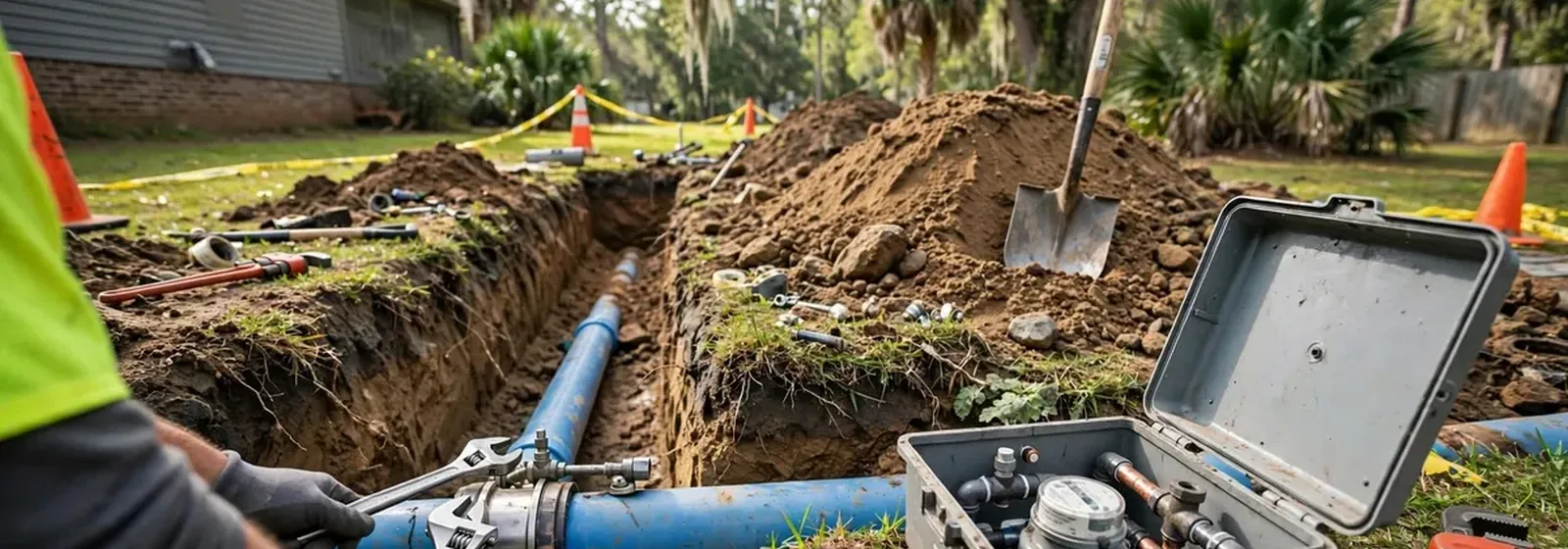
Signs the line from the street is failing
Wet or sunken ground
A soft strip of lawn, a sinking walk or a muddy patch with no rain points to a leak along the pipe route.
Pressure loss at every tap
If the whole house loses pressure at once, the problem is upstream of the branches, often at the main line or the pressure regulator.
Meter moves with everything off
Water leaving through a break registers on the meter even when no fixture is open.
Dirty or sputtering water
Air, grit or rust in the supply after a break or repair can come from a damaged line pulling in debris.
Bill jumps without explanation
A slow underground leak can run for weeks before the bill shows it.
No water or a flooded yard: what to do now
A failed service line is urgent because it can wash out soil, flood a basement wall or leave the house with no supply. Close the main valve inside, turn off the water heater if the house has no water, and call (215) 714-6692. We book same-day visits when available and take after-hours calls on nights and weekends.
Do not dig by hand near the suspected leak before the lines are marked. Pennsylvania requires homeowners and contractors to call 8-1-1 at least three business days before digging, and that wait matters because gas, electric and communication lines may share the route. Plan around it, and use the wait to shut the main and stage containers of water.
Who owns what: meter, curb stop and your pipe
The Horsham Water and Sewer Authority owns and maintains the line from its main in the street to the curb stop. You own the Building Water Service Line from the curb stop to the house, and its repair is your expense. That split decides who gets the first call, so find the curb stop (the Authority asks that it stay accessible) before any dig.
The meter is Authority property too, and it usually sits in the basement along the street-side wall. If water is surfacing between the street and the curb stop, call the Authority business office at (215) 672-8011. If it is surfacing between the curb stop and the house, the repair is yours, and we can start.
Wet lawn, low pressure or no water?
Describe where the line enters the house and what the meter is doing. Call (215) 714-6692 for a same-day visit when available, day or night.
Finding the break without trenching the whole yard
A leak search can narrow a buried line to a few feet. Plumbers typically isolate the line, run pressure checks, and use acoustic gear to hear the leak. A dye or metal locator can follow the route when plans are missing.
That keeps the dig small. A short spot repair in one pit usually disturbs far less lawn and driveway than trenching the full length, and the trade-off is explained to you before work starts. For deeper detail on locating, see our leak detection page.
Repair or replace the service line
Spot repair makes sense when
- The break is isolated and the pipe is otherwise sound
- The pipe material is modern and in good shape
- The route is easy to open in one place
- You want the lowest disruption
Full replacement makes sense when
- The line has failed more than once
- Pipe is old steel, corroded or undersized
- Pressure is weak even with no leak
- You are already tearing up the yard
Typical replacement materials are copper and polyethylene or similar plastic water service tubing, and the right choice depends on soil, route and what the Authority requires. The Authority reports no known lead service lines, though its inventory lists most lines as unknown material. When the old pipe is exposed, have the plumber show you what it is made of and photograph it for your records.
How the repair work goes
- 1
Locate and mark
We confirm the line route, call for utility marking, and choose where to open the ground.
- 2
Isolate and expose
The authority or a valve upstream cuts supply as needed, and we open the pit around the break.
- 3
Repair or replace
We cut out the damaged pipe and install new service tubing with proper fittings, or run a longer replacement.
- 4
Test and restore
We pressure-test, flush the line, check pressure at the fixtures, and backfill. Restoring turf or paving is usually a separate trade.
Low pressure that is not a leak
Weak pressure does not always mean a break. A partly closed meter or main valve, a failing pressure-reducing valve, or old galvanized pipe clogged with scale can all do it. We check the valve, the regulator and the line before recommending digging.
If scaling points to a house-wide issue, the answer may be repiping rather than another repair on the street side. And when a split inside the house is the actual cause, see burst pipe repair.
Before we arrive: prepare for a line repair
Small steps save time on the day.
Locate the main and meter
Clear the path and tell us where the line enters the house.
Gather any paperwork
Old plot plans, prior repair notes or photos of the line help us trace the route.
Mark sprinkler heads and fences
Flag irrigation lines, invisible fences and landscaping that might be in the dig zone.
Plan for no water
Fill a few containers and store drinking water. Close the main to protect fixtures.
What affects the price of water line repair
Your price is stated before work starts. The big drivers:
Depth and length of the dig
A short spot repair is less work than replacing the whole run from the meter to the house.
Ground surface
Soil, driveways, sidewalks and landscaping each change the labor and restoration needed.
Pipe material
Copper and plastic service tubing differ in cost, and old steel may need replacing in full.
Utility coordination
Shutoffs, inspections and permits depend on the authority and the township, so we ask them rather than assume.
Time of the call
After-hours emergency work is priced and explained up front.
Homeowners policies often exclude the buried line itself unless you added coverage. Ask your carrier. Want your real number? Call (215) 714-6692.
Where the plumbers focus on a water line job
The plumbers focus on the customer-side line from the curb stop to the house. The Authority handles its meter and its main in the street, and lawn or paving restoration is its own trade. Whether your project needs a township permit is a question for Code Enforcement at 1025 Horsham Road, (215) 643-3131, open Monday to Friday 8:30 AM to 4:30 PM.
Check the contractor as well as the pipe. Pennsylvania has no statewide plumber license for most construction work, but home improvement contractors doing $5,000 or more a year must register with the Attorney General. Look up any business at hicsearch.attorneygeneral.gov before you sign for a dig that will open your yard.
We help homeowners across the area, including Hatboro and Ambler.
Questions about water line repair in Horsham
Yes. Our dispatch is open 24/7. If your line has broken and the house has no water or the yard is flooding, close the main valve and call (215) 714-6692 for the soonest available same-day or after-hours visit.
The Authority owns the line from its main to the curb stop, and you own it from the curb stop to the house. Meters belong to the Authority. Find the curb stop before any excavation so you know which side of it the leak is on.
If the meter keeps running with every fixture off and also after you close the house main, the loss is outside the shutoff. Wet ground along the pipe route supports it.
No, not by default. We locate the break first and open only where needed. Full-length replacement is offered when the pipe is failing along its length.
A spot repair can be a half-day job, and a replacement takes longer. Depth, utilities and weather matter, and we tell you the plan on site.
It depends on where the break is. Authority rules put its responsibility between the main and the curb stop, while the stretch from the curb stop to your house is the owner's. Call the business office at (215) 672-8011 to report the location, then call us. Leaked water is billed at the regular rate, so do not wait.
Ask Code Enforcement at 1025 Horsham Road, (215) 643-3131, because rules for a service line replacement are not something we state from memory. Township fines apply to work done before a required permit. We tell you what we find on your property.
Sources we checked
Local facts on this page come from these public pages. Plumbing work in Pennsylvania falls under the Uniform Construction Code, which adopts the International Plumbing Code (IPC) provisions, so ask Horsham Code Enforcement which edition applies before a permit is pulled. Rules and phone numbers change, so confirm with the office before you act.
- horshamwater-sewer.com/sites/default/files/2026-02/horsham-water-se... Authority report
- horshamwater-sewer.com/do-you-have-leak Authority report
- horshamwater-sewer.com/did-you-know Authority report
- horshamwater-sewer.com/service-line-inventory Authority report
- horshamwater-sewer.com/contact Authority report
- puc.pa.gov/pipeline-safety/pa-one-call State agency
- horsham.org/10737/Permits Township page
- attorneygeneral.gov/businesses-and-organizations/home-improvemen... State agency
- pa.gov/agencies/dli/programs-services/labor-managem... State agency