Gas smell? Leave first
If you smell gas or hear a hissing near the boiler, do not touch switches or light anything. Leave the house, then call 911 or your gas utility from outside (PECO customers: 1-800-841-4141).
A boiler that sounds alarms, smells like fuel or has soot on its jacket is a carbon monoxide risk. Get everyone outside and call 911.
Before we arrive: stop the damage
If the smell test is clear and water is the only problem, these four steps limit the damage.
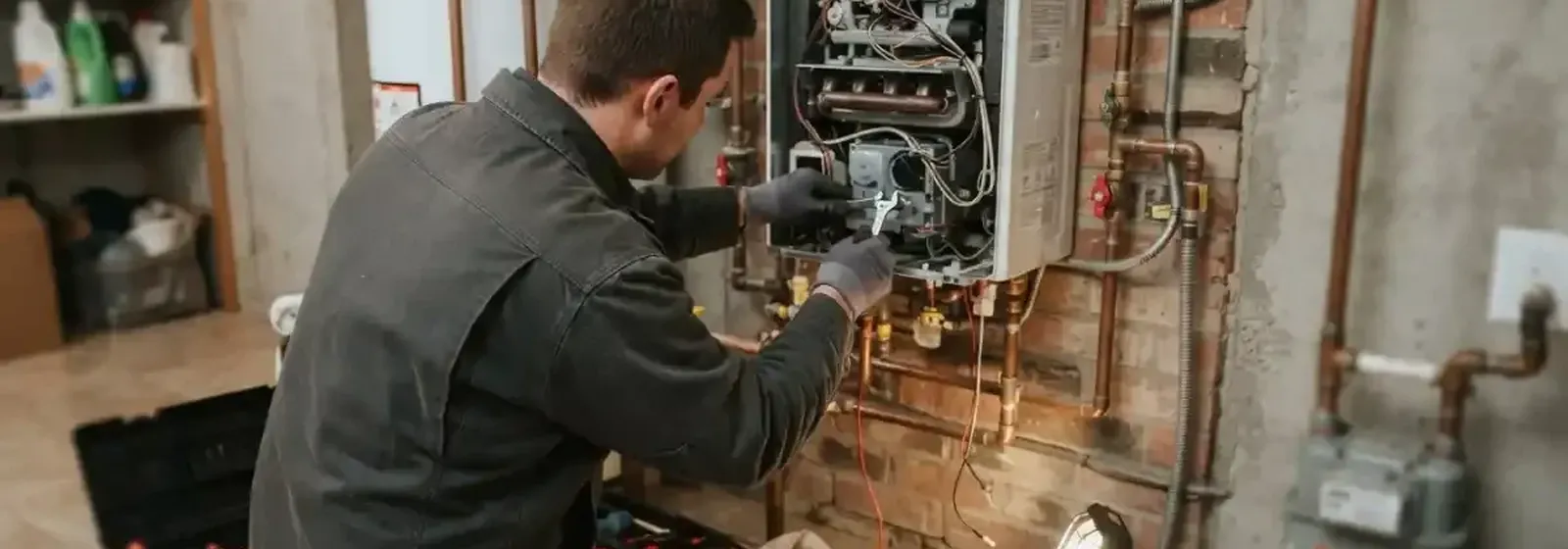
Switch off the boiler
Use the service switch on or near the unit or the breaker. Do this only if the floor around the switch is dry.
Close the fuel supply
Turn the gas valve handle crosswise to the pipe, or close the oil line valve. Leave it off until a technician has looked at it.
Shut the water feed
Close the cold water fill valve to the boiler so it stops topping itself up with fresh water, which also feeds the leak.
Contain the water
Set a bucket under any steady drip, lay towels, and move stored items off the floor. Take a photo of the leak for the technician.
Where boiler leaks actually come from
Not every puddle near a boiler is a boiler leak. Condensate from a high-efficiency unit, a dripping water heater, a sweating pipe or a leaking radiator valve can all land on the same floor. Look at the water's path before assuming the worst.
| Where the water appears | Common cause | Typical outcome |
|---|---|---|
| Pressure relief valve or its discharge pipe | System pressure too high, failed expansion tank or a worn valve | Often repairable |
| Circulator pump flanges | Worn gasket or seals | Usually repairable |
| Threaded pipe joints and valves | Loose or corroded fitting | Usually repairable |
| Boiler drain valve | Debris in the seat or a worn washer | Usually repairable |
| Underneath the boiler body or jacket | Corrosion or cracks in the heat exchanger | Usually means replacement |
| Around the base of a high-efficiency unit | Blocked condensate drain or trap | Often repairable |
Pressure, the relief valve and the expansion tank
A hot water boiler is a closed loop, and it needs a cushion for the water to expand into as it heats. That cushion is the expansion tank. When it loses its air charge, pressure spikes every heating cycle and the relief valve opens to release the excess. Check the pressure gauge on the boiler and the manufacturer's label, as many residential hot water boilers run around 12 to 15 psi cold, though your unit may differ.
A relief valve that drips after a heating cycle is warning you about pressure. Replacing the valve alone does not fix the cause, and a valve that is stuck open can leave you with no heat. Never cap or plug a relief valve discharge, because that valve is the last safeguard against an over-pressure event.
Repairs we can make and ones we cannot
Usually fixable on site
- Worn circulator flange gaskets or a failed circulator
- Leaking relief valve after the pressure cause is corrected
- Loose or corroded threaded fittings and shutoff valves
- A bad expansion tank or fill valve
- Plugged condensate lines on a condensing boiler
Usually points to replacement
- Water coming from inside the boiler jacket or the heat exchanger
- Heavy rust scale at the bottom and sides of the unit
- Repeated leaks at several fittings in a short time
- A cracked cast iron section
- Repair costs that approach the cost of a new unit
A cracked heat exchanger should not be patched. Sealants and epoxies are not a safe or lasting fix for a pressure vessel, and a plumber should say so directly. When replacement is the sensible path, our boiler repair team explains the choices and the work involved before any decision is made.
A leak you cannot see
Sometimes the boiler is dry and the leak is somewhere else in the loop. The clue is a pressure gauge that keeps dropping, an automatic fill valve that clicks on often, or a water bill that creeps up with no change in use. Pipes in a slab, a wall or under insulation can leak a long time before the stain shows.
That is a job for our leak detection technicians, who use acoustic and thermal tools to locate the pipe without tearing out finished surfaces. Do not keep topping up the system by hand. Fresh water adds oxygen and minerals that speed corrosion inside the boiler.
Water near the boiler?
Call (215) 714-6692 and tell us where the water appears and what the gauge reads. We give a clear price before work starts, and same-day appointments are available when the schedule allows.
How the decision usually gets made
Age and rating plate
The label shows the manufacture date. Older units with a body leak are rarely worth repairing.
Where the leak sits
Accessory parts such as pumps and valves are routine. The boiler body itself is not.
Heat season timing
A replacement ordered in autumn takes longer than one scheduled in spring. A repair can bridge a cold week.
Fuel and venting changes
A new boiler may need different venting or a condensate drain, and these details change the scope of work.
Cost depends on the part, the boiler type, access in your mechanical room and the age of the unit. A pump gasket and a heat exchanger are both labelled boiler leaks but they differ completely in effort. We explain the scope and give a clear price before work starts.
Neighboring towns
We take boiler calls in Maple Glen and Warminster as well as Horsham. The first question is always the same: is the leak from the boiler or from the loop, and is it safe to run the system until we arrive?
Plumbing in Horsham: heating fuel, permits and the gas line
Census figures for 2020 to 2024 count 9,857 occupied homes in Horsham Township, with 1,704 heating with fuel oil (about 17 percent), 4,011 with utility gas and 3,696 with electricity. Those counts cover all heating systems, not only boilers. Even so, your boiler may be oil, gas or electric, so know which fuel you burn before you call. That tells you which valve the fuel shutoff step above means.
The township's permit page lists heating and air conditioning replacement, and fuel tanks, as work needing a permit. Code Enforcement is at 1025 Horsham Road, (215) 643-3131, open Monday to Friday 8:30 to 4:30, and inspections need 24 to 48 hours notice. If your leak ends in a new boiler, build that wait into a cold week.
Your gas bill names your gas utility. PECO customers call 1-800-841-4141 to report a gas leak, and others use the number on their bill. Anyone who smells gas leaves first and calls 911 or the utility from outside.
Questions and answers
Not safely if the leak is steady, comes from the boiler body or is near electrical parts. Switch it off, close the fuel, and call. A slow drip at a valve may be run for a short time under supervision, but let a technician decide.
Most often system pressure is too high, often from a failed expansion tank or an overfilled system. The valve may also have worn out. Check the gauge and call a technician. Do not plug the discharge pipe.
Yes. Horsham 24/7 Plumbing takes boiler leak calls around the clock at (215) 714-6692. While you wait, switch off the boiler, close the fuel valve, shut the water feed and contain the water. If you smell gas, leave and call 911 or your gas utility first (PECO customers: 1-800-841-4141).
Leaks at pumps, valves, relief valves and fittings are usually repairable. Water from inside the boiler jacket, a cracked heat exchanger or heavy rust scale usually means replacement. Our boiler repair team inspects before recommending.
A dropping gauge means water is escaping the system, either at a visible spot or through a hidden pipe leak. Our leak detection technicians locate hidden leaks without opening up more of the wall than needed.
Yes. The township permit page lists heating replacement and fuel tanks as work needing a permit. Call Code Enforcement at (215) 643-3131 before work starts, since inspections need 24 to 48 hours notice. A repair such as a pump or valve is a separate question, so ask about that too.
Sources we checked
Local facts on this page come from these public pages. Plumbing work in Pennsylvania falls under the Uniform Construction Code, which adopts the International Plumbing Code (IPC) provisions, so ask Horsham Code Enforcement which edition applies before a permit is pulled. Rules and phone numbers change, so confirm with the office before you act.