Warning signs that point underground
A bill that jumped with no change in habits
A steady leak runs day and night. Compare the last few months of usage, not just dollars.
Water pressure dropped
A broken service line bleeds pressure before the water reaches your fixtures, so showers weaken everywhere at once.
A soggy or unusually green strip of lawn
Soil that stays wet in dry weather, or a stripe of faster grass, can sit right over a leaking pipe.
The sound of running water in a quiet house
A hiss or trickle near the meter or a wall, with every fixture off, suggests flow you are not using.
A warm spot on the floor
A hot-water line leaking under a slab can warm the flooring above it.
Meter keeps spinning
This is the surest sign, and the next section shows how to check it.
The meter test: confirm a leak in about an hour
The register on a water meter cannot move unless water is moving through it, which makes the meter your best free detector. The Horsham Water and Sewer Authority describes the same method on its website: make sure no one is using water, locate the meter, and read the register. If the numbers move while everything is off, you most likely have a leak.
- 1
Stop all water use
Turn off the dishwasher, washing machine, ice maker and irrigation. Tell everyone in the house not to flush.
- 2
Find the meter and note the reading
Meters often sit in a basement near the street-side wall, in a crawl space or in a utility room. Write down the register digits and look for a small low-flow dial or triangle that spins at tiny flows.
- 3
Wait and compare
Wait 30 to 60 minutes, or read it again after an overnight pause. Any movement with all fixtures off means water is escaping somewhere.
- 4
Close the house main and test again
Shut the valve where the water line enters the house, then check the meter. If it still moves, the leak is between the meter and that valve or on the outside line. If it stops, the leak is inside.
Rule out the easy leaks first
Toilets cause more indoor leaks than any other fixture. Drop a dye tablet or a few drops of dark food coloring in the tank, wait about 20 minutes without flushing, and see whether color shows in the bowl.
Check hose bibs, outdoor spigots and any irrigation line too. A running toilet can mimic an underground leak on a meter test, so do this before you pay to dig.
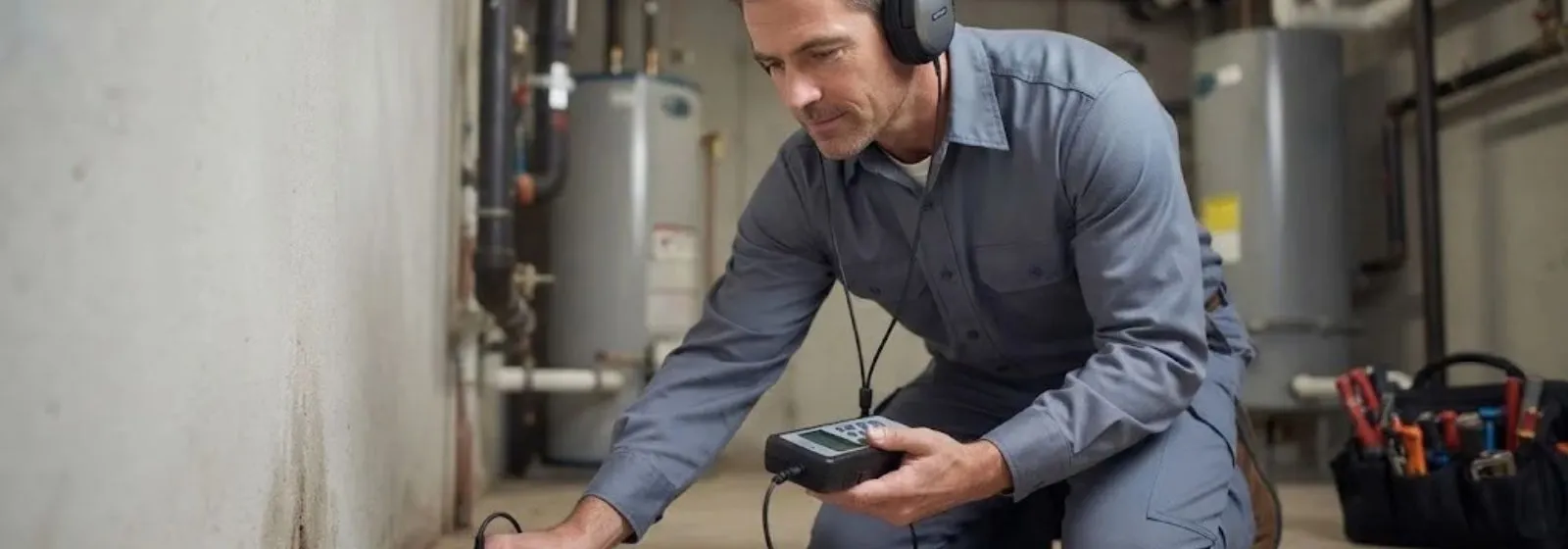
How professionals pinpoint the leak without digging up the yard
| Method | What it detects | Best for |
|---|---|---|
| Acoustic listening | The hiss or vibration of pressurized water escaping | Pressurized service lines and pipes under hard surfaces |
| Ground microphone and correlator | Time difference of the noise at two points on the pipe | Longer runs where the exact spot is unknown |
| Thermal imaging | Temperature differences from hot-water leaks or wet materials | Slabs, walls and radiant lines |
| Tracer gas | A harmless gas escaping from the pipe and rising through soil | Quiet leaks that make little noise, such as plastic pipe |
| Pressure testing | Pressure loss when sections of the system are isolated | Narrowing leaks between the meter and the house |
No single tool finds every leak. Plastic pipe is quiet, so acoustic gear works better on metal, and tracer gas is often the backup. A good locator combines two methods and marks the spot on the surface, so the dig is the size of a manhole cover and not a trench.
Meter still moving with everything off?
That result is enough to book a locator. Our leak detection crews can trace the line and mark the spot. Call (215) 714-6692.
Who owns the pipe where the leak is
In the Horsham Water and Sewer Authority's rules, the Authority owns and maintains the water service pipe from its main in the street to the curb stop. From the curb stop to the house, the customer owns and maintains the building service line at the customer's expense.
That split matters because most hidden leaks that homeowners find sit in the customer's section. If a plumber's marking puts the leak on the street side of the curb stop, call the Authority before you pay for a dig. If it sits on your side, our water service line repair team can scope the fix.
What to do before anyone digs
Before excavation starts
- Photograph the meter reading and the wet area
- Shut off the house main if water is surfacing or flooding a basement
- Call 811 at least three business days before digging
- Do not dig where lines are unmarked or near the street
- Keep the meter reading log for your records
- Ask the plumber for the marked location and the reason it is the likely source
Pennsylvania law requires homeowners and contractors to call 811 at least three business days before any excavation so facility owners can mark buried lines. Water, sewer, gas, electric and cable can all share a front yard, and a shovel through the wrong one is far worse than a leak.
Water service in Horsham: what the local record says
The Horsham Water and Sewer Authority states on its leak page that leaks are the customer's responsibility to find and fix once they are on the customer's side of the connection, and that fixes should happen immediately. The Authority adds that it may attempt to help customers locate a leak, and it lists its main office at 215-672-8011.
Its published rules also say that no allowances are made for water that passes through the meter because of leaks. In practice, a slow leak that goes undiscovered stays on your bill at the regular rate, so a meter test on a quiet evening is a cheap way to avoid paying for months of lost water.
For water that is surfacing in the street or a main-side break, the Authority handles emergencies. North Wales Water Authority crews assist at the Authority's direction, and the Authority asks customers not to call North Wales offices about Horsham leaks. Call the Horsham Authority first.
Questions and answers
Shut the valve where the water line enters the house, then watch the meter. If it keeps moving with that valve closed, the leak is outside the house or on the line before the valve. If it stops, the leak is inside.
The Authority says it may attempt to help customers locate a leak, but finding and fixing leaks on the customer's side is the customer's job. Call 215-672-8011 to ask what help is available for your address.
Its published rules state that no allowances are made for consumption due to leaks. Ask the Authority directly if you believe your case is unusual, but do not count on a credit.
Yes. Pennsylvania requires 811 notice at least three business days before excavation, and a plumber usually handles the call. Ask to see the ticket number.
Simple cases take a short visit, while quiet plastic lines or multiple leaks can take longer. We do not promise an arrival or completion time before we see the property, and we give a clear price before work starts.
Yes. Our crews also work in Warrington and Ambler, where the water supplier and pipe ownership rules can differ from Horsham, so we confirm the local boundary first.
Sources we checked
Local facts on this page come from these public pages. Plumbing work in Pennsylvania falls under the Uniform Construction Code, which adopts the International Plumbing Code (IPC) provisions, so ask Horsham Code Enforcement which edition applies before a permit is pulled. Rules and phone numbers change, so confirm with the office before you act.
- horshamwater-sewer.com/do-you-have-leak Authority report
- horshamwater-sewer.com/sites/default/files/2025-05/horsham-water-se... Authority report
- nwwater.com/horsham-water-and-sewer-customers Authority report
- puc.pa.gov/pipeline/pa-one-call State agency