Start with what your sink and cabinet can take
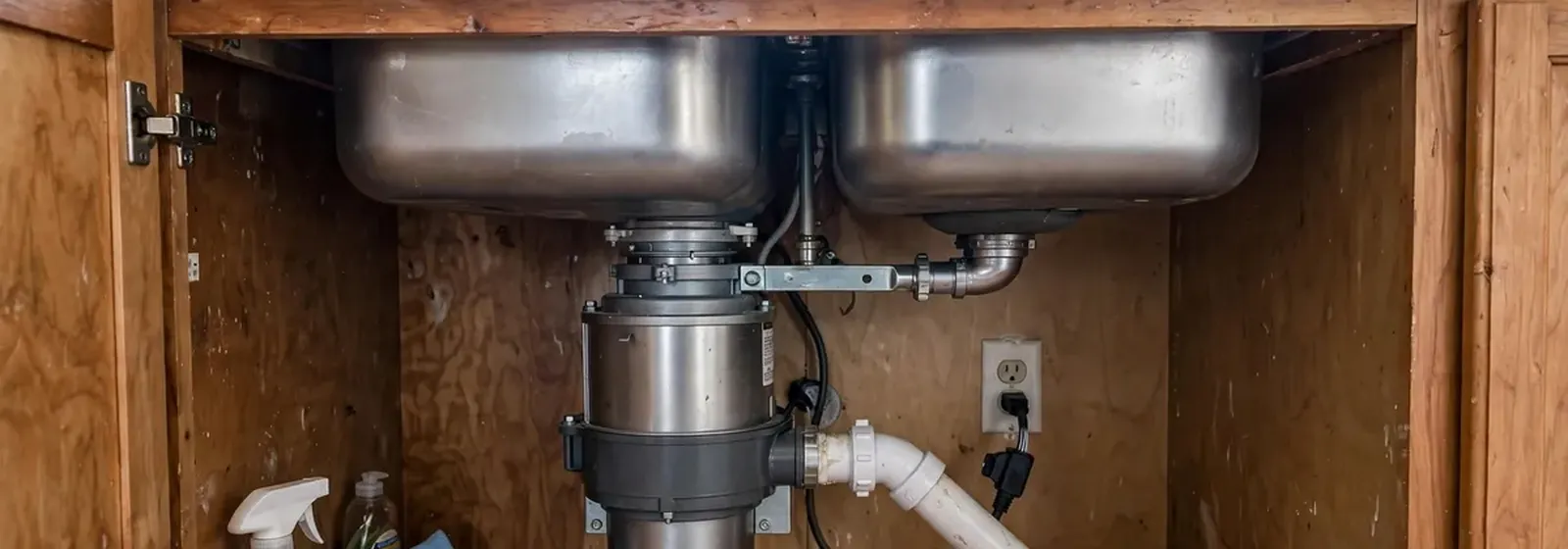
Check three things before you buy: the sink flange opening, the space under the sink and the drain layout. Most kitchen sinks use a standard 3.5 inch drain opening, and InSinkErator disposals mount with a clamp-style assembly that fits it. A shallow cabinet or a deep single bowl can leave less room for the unit, so measure from the flange down to the trap.
Sinks with a second bowl or a dishwasher add one more question. The disposal will connect to the dishwasher drain through a small side inlet, and the hose has to rise above the drain line before it connects. That loop is what keeps dirty sink water out of your dishwasher.
Picking horsepower and feed type
| Choice | Lower end | Higher end |
|---|---|---|
| Motor size | Roughly 1/3 to 1/2 HP for light use and a small household | 3/4 to 1 HP for heavy cooking and larger families |
| Feed type | Continuous feed: flip a switch, add scraps while it runs | Batch feed: lock the stopper in place and twist to start |
| Noise | Basic models run louder | Models with extra insulation run quieter |
| Cabinet fit | Compact bodies suit tight cabinets | Larger motors need more depth below the flange |
A bigger motor handles fibrous scraps and bone fragments more easily, but it is not a license to put everything down it. A continuous-feed unit is simple, while batch feed adds a safety step that some households prefer around small children. If you cannot decide, a mid-range motor covers most family kitchens.
What goes into the installation, step by step
- 1
Cut power and clear the cabinet
Turn off the breaker for the kitchen circuit, then confirm the outlet or switch is dead with a tester. Empty the cabinet and lay down a towel or tray.
- 2
Remove the old drain or disposal
Disconnect the trap, loosen the old mounting ring and lift out the old sink strainer. Scrape off the old plumber's putty before the new flange goes in.
- 3
Mount the flange and the unit
Set the new flange in fresh putty, secure the mounting assembly from below and hang the disposal on its lugs. Rotate it until the discharge faces the trap arm, then lock it.
- 4
Connect the dishwasher and drain
If you have a dishwasher, knock out the plug inside the disposal's dishwasher inlet before attaching the hose, or the dishwasher will not drain. Reconnect the trap with new slip joints.
- 5
Wire, test and run
Connect the power cord or the hardwired leads, restore the breaker and run water for a test. Check the mounting ring, the hose clamp and every slip joint for drips with a dry paper towel.
The one step people forget
Most dishwasher drain connections on a disposal ship with a solid knockout plug in the inlet. If the plug is left in, the dishwasher fills with dirty water after every cycle. Remove it with a hammer and screwdriver, then fish the loose piece out of the disposal chamber.
If the plug has already dropped inside the disposal, it can jam the grind plate, so the unit should never be turned on before it is retrieved.
When a plumber should do the job
No outlet or switch under the sink
A new circuit or switch has to be run to code, and electrical rules belong with a licensed electrician or a plumber working with one.
Corroded or slow sink drain
Installing a disposal on a drain that is already scaled up passes the clog to a new machine. A drain fix comes first.
Mismatched pipe sizes
Older kitchens with odd trap arms or galvanized drain stubs often need new fittings before the disposal can seat.
Leaking from the unit
A leak from the flange, the dishwasher inlet or the body can mean a bad seal or a cracked housing. See our garbage disposal repair page for repair options.
Want it mounted and tested the same visit?
We remove the old unit, set the new one and run it through a leak test before we leave. Call (215) 714-6692 to get on the schedule.
What a disposal should never see
A disposal grinds food into small particles, but it does not make grease, starch or fibers safe for your pipes. Grease cools and coats the drain wall, rice and pasta swell into paste, and celery strings wrap around the grinding parts. Run cold water before, during and for about fifteen seconds after use to carry the waste down the line.
Keep out of the disposal
- Cooking grease, oil and fatty meat trimmings
- Coffee grounds in large amounts
- Pasta, rice and bread that swell in water
- Potato peels, artichoke and corn husks that mat or string
- Bones larger than a small chicken bone
- Egg shells in bulk, onion skins and fruit pits
- Any non-food object, including bottle caps and utensils
What affects the cost of installing a disposal
What affects the price of a disposal installation
The unit is only part of the invoice. These are the variables a plumber weighs before quoting.
Motor size and model
Higher horsepower and more sound insulation raise the price of the unit itself.
Replacement versus first-time install
Swapping an existing disposal reuses the mounting and wiring. A first-time install may need a new drain flange, a trap rebuild and power.
Electrical needs
Adding an outlet or a switch under the sink is separate work and may need a permit.
Dishwasher and drain condition
A worn drain hose, a missing high loop or a scaled-up drain adds parts and time.
Haul-away and cabinet access
A tight cabinet slows the work, and old units need to be disposed of.
Homeowners insurance usually will not cover a disposal you install and then break, so keep the receipt and the warranty card. Want your real number? Call (215) 714-6692.
If you also plan other kitchen changes, a new faucet or sink can be handled at the same visit under our plumbing installation service, which keeps the drain work in one trip.
Drains in Horsham: what the local record says
The Horsham Water and Sewer Authority publishes a wipes and fats, oils and grease sheet that names garbage disposals directly: homeowners with a disposal should follow the same grease rules and keep fatty foods out of it. The sheet says grease hardens as it cools and sticks to the walls of sewer pipes, and that hot water does not prevent this. Its advice is to collect grease in a lidded can and wipe pans with a paper towel before washing.
Its rules also state that the customer installs and maintains the building lateral, the pipe from your house to the property line. A kitchen drain that keeps clogging despite a new disposal may point to grease buildup in that pipe, and the sewer camera inspection tells you which part of the line is the problem.
Check with the Horsham Township code enforcement office on whether your job needs a plumbing or electrical permit, because permit rules vary by project. If you are adding a new circuit, ask before you start.
Questions and answers
No. The Horsham Water and Sewer Authority's own guidance says grease hardens as it cools and sticks to sewer pipe walls, and that applies to disposals too. Run only soft food scraps through the disposal and put cooking grease in the trash.
The mounting and plumbing are doable with basic hand tools and an afternoon. Wiring, a dead dishwasher drain after the plug is left in, and slip joint leaks are the places most DIY jobs go wrong.
Many residential disposals run for years with regular use and cold water flushing, but lifespan depends on the model, the load and how often it gets jammed. A unit that hums without grinding or leaks from the body is the usual end of life sign.
Permit rules vary by project, so ask the Horsham Township building department before you start. A simple swap of the same unit is different from adding a new circuit or moving plumbing.
Yes, as long as the dishwasher drain hose attaches to the disposal's side inlet with the knockout plug removed and a high loop in the hose. Without the loop, sink water can flow back toward the dishwasher.
Sources we checked
Local facts on this page come from these public pages. Plumbing work in Pennsylvania falls under the Uniform Construction Code, which adopts the International Plumbing Code (IPC) provisions, so ask Horsham Code Enforcement which edition applies before a permit is pulled. Rules and phone numbers change, so confirm with the office before you act.
- horshamwater-sewer.com/sites/default/files/wipes-fog_horsham.pdf Authority report
- horshamwater-sewer.com/sites/default/files/2025-05/horsham-water-se... Authority report
- horsham.org/10737/permit-requirements Township page